

We read – and, above all, we see and hear – a lot of nonsense about the massage industry in Thailand.
I’ve recently watched some videos on YouTube and I can confirm it : those so-called content creators often talk utter rubbish.
For example, a certain Jona – a very trendy Belgian YouTuber who is a genuine web entrepreneur and millionaire, with thousands of subscribers who hang on his every word and devour his videos – claims in a video about massages that it’s easy to tell the difference between those who offer sexual services and those who don’t.
He claims that those offering sexual services generally don’t display their prices and that the girls wait outside the parlour scantily clad, whereas in reputable parlours, according to him, prices are displayed and the masseuses all wear the same professional uniform. That’s absolute rubbish. And the fact that someone like that, who spouts such nonsense, is idolised by thousands of people, annoys me a bit.
There are three types of massage parlours in Thailand :
1 – ‘Brothels’
Why do I call this first category ‘brothels’ ?
Because these are genuinely establishments where the aim is to sell sex. Officially, prostitution is illegal in Thailand.
But, mainly in Bangkok and a few other major tourist cities, there are establishments with a high street presence and often a website where the services on offer are clearly listed. A photo gallery allows you to choose the girl you wish to book, as well as the level of service – with prices rising as the number of options increases. Without going into too much detail, the top tier on these sites is booking a VIP room. You’ll therefore be welcomed by a sex worker in a room with a jacuzzi-style bath, and she’ll take a bath with you, during which she’ll provide a full body-to-body massage. Afterwards, of course, it’ll end in bed with full sexual intercourse.
This information can be found online ; I’m not providing a link here, but you can easily find this type of website with prices listed at a few thousand baht.
This category accounts for only a few massage parlours, probably 1 or 2 per cent across Thailand.
2 – ‘Tourist’ massage parlours
We’re talking here about 90 per cent of massage parlours in Thailand in tourist areas. Please note that I have specifically written ‘in tourist areas’.
It’s important to realise that, contrary to the accounts of quite a few expats, massage parlours in this second category do not exist in traditional Thailand – particularly in villages and suburbs where there are no foreigners. I’ll come back to this a little later in the article.
In these villages, which see little tourism, you’re more likely to find massage parlours of the third category, which I’ll discuss later.
What can you find in these parlours that I call ‘somewhat touristy’ ?
First and foremost, most of the time, good-quality massages. And this is true regardless of the shop front. For example, in Hua Hin, where I live, many of these parlours are tiny little shops, often in single-storey terraced houses. Very often, there’s a bench or some chairs outside with girls of varying ages sitting there, who don’t hesitate to call out to passers-by with a ‘Hello massage’. They might just call out to you, or sometimes adopt a more suggestive manner to encourage you to come in.
Prices are always clearly displayed outside.
Typically, the signs advertise traditional Thai massage, oil massage, foot massage, and sometimes sports massage, etc.
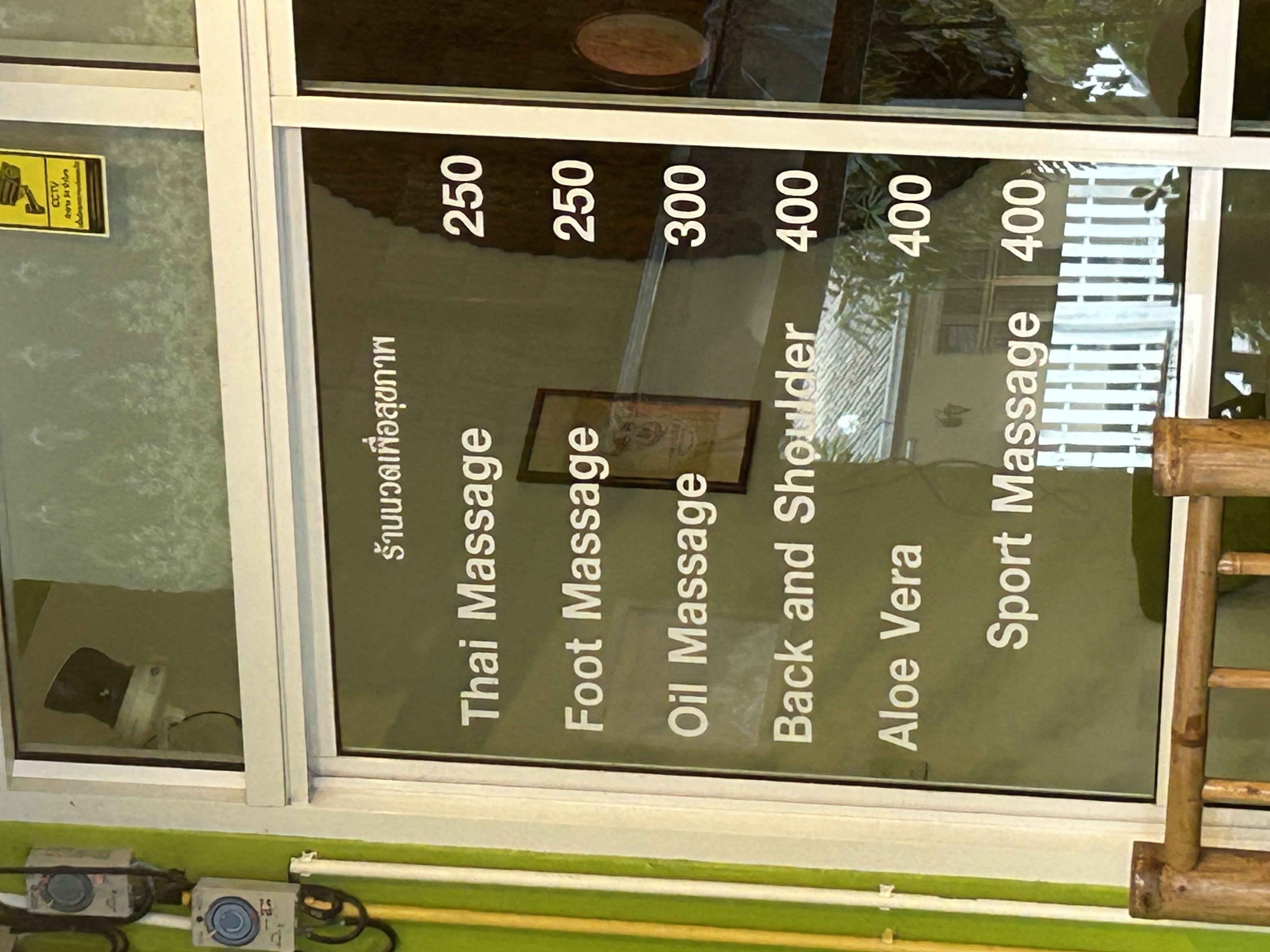
In these small parlours, if you’re a man on your own, you’ll be led to a discreet room at the back by one of these women, who are generally quite pretty and very well made-up.
Some of these establishments have a first floor, in which case you’re likely to be taken to the first or second floor to an even more discreet room.
If you come as a couple, you’ll usually be given two adjoining cubicles separated only by a curtain.
Foot massages generally take place in armchairs in the salon’s front room – often behind a glass display case, which allows passers-by to enjoy the spectacle.
Thais are very fond of foot massages ; they’re extremely pleasant and you come out feeling relieved.
Make no mistake ! The fact that the masseuses are attractive young women in sexy outfits doesn’t mean that, in most cases, the massage won’t be of fairly good quality.
The most enjoyable massage is the oil massage because it’s generally a bit gentler. If you choose a traditional Thai massage, the masseuse will usually ask if you want ‘normal’ (sometimes they’ll say ‘strong’), ‘medium’ or ‘light’ (soft).
I’d generally advise you to choose ‘medium’ so that the massage isn’t too rough, but is still effective. But don’t leave Thailand without having tried a ‘normal’ Thai massage at least once. You’ll come out feeling as though you’ve been run over by a lorry, but I can assure you that the next day you’ll feel great.
In the vast majority of salons of this type, you can either keep your underwear on (your briefs or boxers) or take them off. Usually, the masseuse will take you into the treatment room, switch on the air conditioning if it isn’t already on, and give you a minute to undress before returning. When the masseuse returns, if you’ve kept your underwear on, she’ll sometimes simply ask you to lie down without comment and begin the massage.
Sometimes she’ll ask you to undress completely.
In any case, you’ll start by lying on your stomach, and the masseuse will work on your back and legs. Some start with the legs, others with the back.
The massage table is generally quite firm. Nevertheless, you’re sometimes quite comfortable, especially when the table has a hole for your face – which isn’t always the case ; sometimes it’s just a cushion.
The back massage usually takes a good half an hour of the hour-long session. Obviously, if you’re completely naked, there’ll also be a massage of your buttocks, which is particularly pleasant, it has to be said.
You’ll then be asked to turn onto your back, and the masseuse will start massaging the front of your thighs and calves. It’s very often at this point that she’ll ask you : “Do you want something special ? ’
She’s asking if you’d like a special massage. A special massage is quite simply what’s often referred to in literature on the subject or in YouTube videos as a ‘happy ending’. Literally, this term translates as ‘joyful ending’. I’ve never heard a single masseuse use this term ; I don’t know where it comes from.
A ‘special massage’ is therefore generally a form of masturbation. The masseuse will massage the client’s private parts until he experiences pleasure. It’s as simple as that.
This additional massage service is paid directly to the masseuse, who usually charges 1,000 baht (€26) in total for the massage and the ‘special massage’. If the advertised price for the massage is 300 baht, she’ll put 300 baht in the till and keep 700 baht for herself.
I imagine that some might be willing to go further, for an additional fee, of course.
Contrary to what the smart alec claims in his YouTube video, the ‘special massage’ is likely to be offered in just about every massage parlour, whether it’s a tiny parlour in a private home or a much larger one with all the staff in smart uniforms and the owner at the entrance, sitting at her desk or welcoming customers. Whether the parlour is upmarket or not, whether it’s expensive or cheap, there will be masseuses who offer a ‘special massage’ and others who don’t.
One of the best ways to avoid being offered this service – or at least to nip the suggestion in the bud – is to keep your underwear on and lie down like that before the masseuse enters.
I’ll come back to what we might make of these practices at the end of the article.
3 – Purely therapeutic massage parlours
On my street, there’s a parlour called Popular Massage. The prices are displayed outside the parlour, and you can see ladies of varying ages in green uniforms.
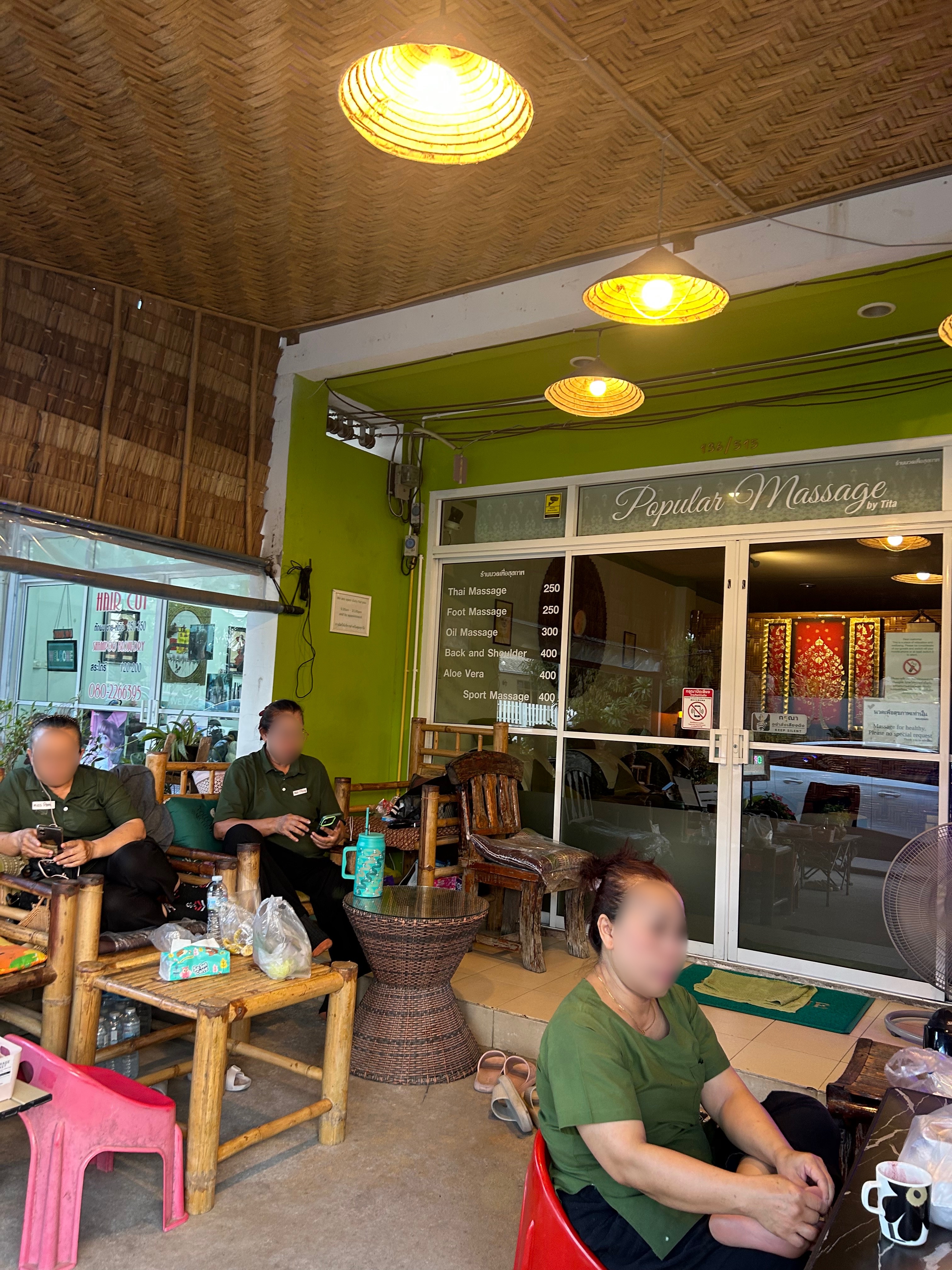
These girls are far from being sexy young women. They’re more what you might call ‘mature ladies’ ; they’re quite sturdy and, although like all Thai women they’re very well-groomed, you can’t say they’re particularly attractive, but they’re truly skilled professionals in therapeutic massage. They know how to treat the areas where you’re in pain, focusing on tender spots that they’ll identify themselves as they work on you.
They’re capable of performing little miracles. I went there last year with a persistent case of tendonitis in my shoulder that was really getting in the way of my golf game.
It took just two sessions of an hour and a half each, two days apart, to make the tendonitis disappear completely.
When the pain occasionally returns a little, I go back to Popular Massage for a session – usually an hour – and that’s enough.
On the salon door, alongside the price list, there’s a small, very clear sign that says something like : ‘We only offer therapeutic massages here. No special requests, please.’
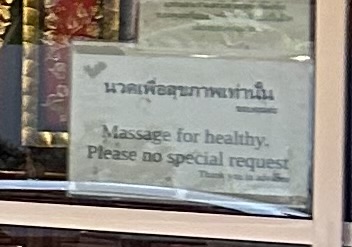
On the same street, Soi 102, there’s another massage parlour, Kaya Massage, which claims the same positioning.
This is clearly a traditional Thai massage parlour. But the perception amongst tourists, particularly men, is that such parlours are rare.
In reality, they’re only rare in very touristy areas :
Bangkok city centre
Phuket
Pattaya
Koh Samui
Other islands that attract large numbers of tourists.
But Thailand is a vast country, and these heavily touristed areas represent only a tiny fraction of the country.
Throughout the rest of the country – in towns and villages – you’ll find almost exclusively third-category parlours.
Sometimes, in villages and small suburban towns, it isn’t even a massage parlour, and there isn’t even a sign out front indicating that it’s a place where you can get a massage ; nor are there any prices displayed, but people know about it through word of mouth, there’s a woman or a man in this house who gives good massages.
So you go to find the masseur or masseuse, and if they’re available, they’ll see you straight away. Otherwise, they’ll arrange an appointment and give you a price, which you generally pay in cash, of course ; that’s how it works.
That is the reality of traditional Thai massage.
I’m not going to go into detail in this article about what traditional Thai massage involves – using the hands, elbows, feet and so on.
I’ll finish by summarising and setting the record straight on everything circulating on social media, particularly on YouTube channels, all of which are run by immigrants (they don’t like being called immigrants ; it’s better to say ‘expat’ – it sounds classier).
-* It is often farangs
farang
farangs
« farang » est un terme générique désignant les Occidentaux blancs, principalement utilisé en Thaïlande et au Laos. Le mot a des origines persanes, provenant du mot « Francs » et s’est répandu pour désigner les Européens occidentaux.
living in Thailand who spread rather misleading images of the country.
- In certain busy parts of Thailand, a massage can sometimes take a turn that is… shall we say, more ‘personalised’. A discreet suggestion at the end of the session, a knowing smile, and suddenly the world of wellness veers off into something decidedly less therapeutic.
From there, it’s only a short step to seeing this as a local tradition – a step that many take with disconcerting confidence. Yet this is a classic mistake. No, Thai massage was never intended as a gateway to ancillary services. This oversimplification often says more about the expectations of certain visitors than about the culture of the country they claim to be discovering.
I’m no historian, but this ‘tradition’ of risqué massage seems to have emerged in the 1970s, during the first major development boom in South Asia.
Did it start with advances from the masseuses or with requests from slightly wealthy tourists who came for a massage ? I have no idea.
- The following myth is just as persistent : that Thai women turn a blind eye, preferring this kind of occasional indiscretion to a more serious extramarital affair. A convenient idea, almost reassuring… and above all terribly simplistic. As elsewhere, reactions range from forced indifference to outright disapproval. But to reduce an entire society to a form of silent tolerance is, above all, to project one’s own moral standards onto the tropics.
So these practices do exist, but they are less a matter of culture than of a market. And as is often the case, this market adapts very effectively to what certain clients hope to find there.
What are we to make of the women who accept and/or offer this sort of ‘special’ massage ?
To begin with, I don’t think we should judge them.
One might ask whether they are prostitutes ?
I think (and this is just my personal view) that when these women offer a ‘special’ massage or masturbation, they obviously do not do so for pleasure, but they do not compromise their own intimacy in the process.
As far as I know, they remain fully clothed and the clients do not touch them.
Why do they offer this sort of ‘bonus’ ?
Precisely because, for them, it’s a huge financial bonus.
For a massage in a medium-sized town like Hua Hin, the average price is 300–350 baht. Except for salons located in modern shopping centres, such as Market Village or Bluport, where the cost of the premises obviously justifies much higher rates.
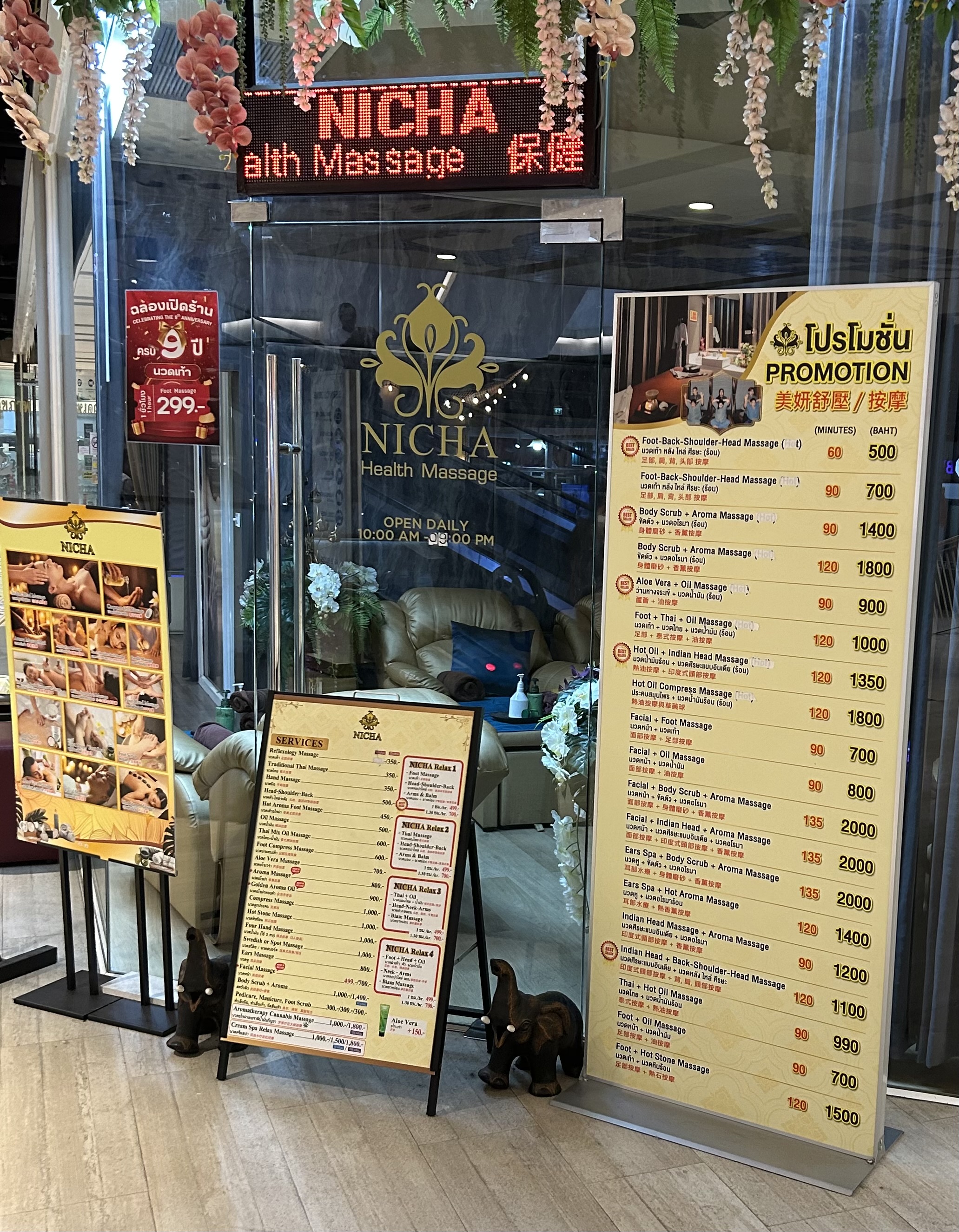
300 baht for an hour of very physical work for these women isn’t much, especially as the 300 baht doesn’t all go into their pockets.
Apart from a few who are self-employed, the masseuses work in a salon that doesn’t belong to them ; so part of those 300 baht goes into the owner’s till, who needs to make a bit of a profit as well as paying the electricity bill for the air conditioning, supplies of oil and all the necessary equipment, such as towels and sheets that have to be changed after every client.
In principle, half goes to the salon and half to the masseuse. That works out at 150 baht for an hour of fairly physically demanding work. Knowing that 150 baht is around €4 doesn’t really give a true picture of what that amount is worth.
Here’s a more telling example : a plate of street food costs around 50 baht. During her long working day (around 12 hours), the masseuse will probably eat three times. Thais don’t have full meals like in Europe ; they eat a dish when they’re hungry.
She will therefore spend 150 baht a day on food.
Masseuses report seeing between 2 and 4 clients a day.
At the end of the day, after paying for their meals, they’ll be left with 450 baht at best. They have to make do with that ; it’s not much.
When they offer a ‘special’ massage, they will often ask, as I mentioned earlier, for 1,000 baht including the massage. They will therefore earn 700 baht more than for a standard massage.
That makes all the difference to them. And these women, young and old alike, often have children, parents or grandparents who no longer work but have no pension, and whom they look after.
The sad reality is that for most of these masseuses, if they didn’t offer ‘special’ massages, they wouldn’t be able to make ends meet.
Thailand will need to change in this respect too, but that takes time.